
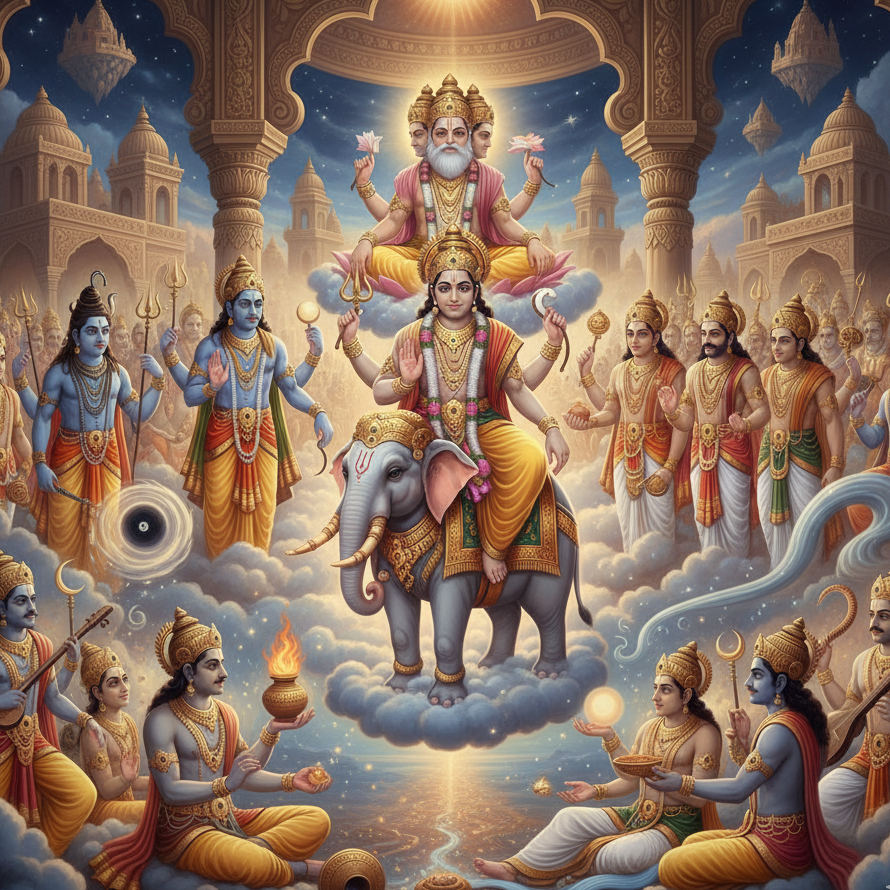
The concept 33 koti deva in Hinduism refers to 33 types of principal deities, not 33 crore gods. In Sanskrit word koti has two meanings: ‘category’ or ‘type’ and ‘crore’.
33 koti deva are classified into four main groups.
Group 1: 8 Vasu
These are also known as Astvasu. Vasu means dwellers and they represent fundamental natural forces. In some Hindu texts they are described as the children of Sage Kashyapa and daughter of Daksha, Aditi. Their names are as follows,
Dhara means Earth
Anala means Fire
Anila means Wind
Aapa meansWater
Pratyusha means Sun
Prabhasa means Sky
Soma means Moon
Dhruva means Pole Star
Group 2: 11 Rudras
They are also known as Ekadasha Rudras and they are manifestations of Lord Shiva. As per Shiv purana Rudras are born from Sage Kashyapa and Surabhi also known as Kamadhenu to protect gods and Indra. Their names are as follows,
Kapali
Pingala
Bheema
Virupaksha
Vilohita
Shastra
Ajapaad
Ahirbudhnya
Shambhu
Chanda
Bhava
Group 3: 12 Adityas
These are groups of major solar deities in Hinduism. They are the children of Sage Kashyapa and daughter of Daksha, Aditi. They are also considered as different forms of the Hindu God, Surya or Sun. Their names are as follows,
Dhata
Aryaman
Mitra
Varuna
Indra
Vivasvan
Tvashta
Vishnu
Amshuman
Bhaga
Pusha
Parjanya
Group 4: 2 Ashvins
These are also known as Ashwini Kumaras; they are twin deities in Hinduism who are also known as gods of medicine and health.They are sons of Surya (the Sun God) and Saranyu (daughter of Vishwakarma, the divine architect in Hinduism). Their names are as follows,
Nasatya
Dasra