
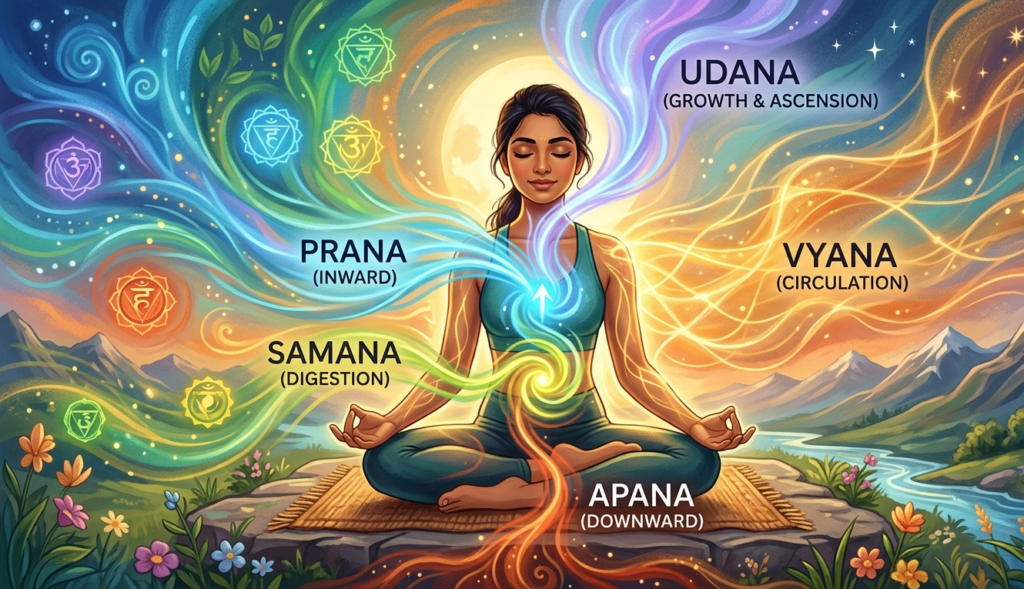
In yoga philosophy, there are five Vayus; these are movements of prana, the vital life force within the body. They govern the flow of energy and physical movement in the body.
Five Vayus and their importance of Each Vayu:
प्राण वायु (Prana Vayu):
Prana Vayu is an upward and inward-moving energy current. Prana Vayu is primarily located in the head and chest, though it circulates through the nose, mouth, and throat. It governs essential functions such as respiration and the intake of food and sensory information. Additionally, it regulates mental awareness and intellectual capacity.
अपान वायु (Apana Vayu):
Apana Vayu is defined as the downward and outward-moving energy current. It is located around मूलाधार चक्र (Muladhara also means Root Chakra). Situated in the lower abdomen and pelvic floor, this energy circulates through the intestines, rectum, kidneys, bladder, and reproductive organs. It governs vital functions, including excretion, reproduction, and the regulation of the menstrual cycle.
समान वायु (Samana Vayu):
Samana Vayu is centered at the navel and located around the मणिपूर चक्र (Manipura chakra means solar plexus chakra). Situated in the intestines, it works on functions like nutrient absorption and metabolism. It governs, stimulates, and balances the digestive fire.
उदान वायु (Udana Vayu):
Udana Vayu is an upward-moving energy current, primarily located in the throat, chest, and nose. It governs communication, speech, and self-expression. Furthermore, it governs the ability to express your thoughts through speech.
व्यान वायु(Vyana Vayu):
Vyana Vayu is an outward-moving energy current. It governs the circulatory, nervous, and muscular systems. It is responsible for muscle coordination, body function control, and the distribution of nutrition throughout the entire body.
These Vayus govern the energy currents regulating bodily functions. If there is an imbalance in these Vayus, it creates an imbalance in the body, proportional to their specific functions. Practice meditation, mudra, and pranayama techniques under the supervision of an ayurvedic and yoga educator to correct these imbalances.